
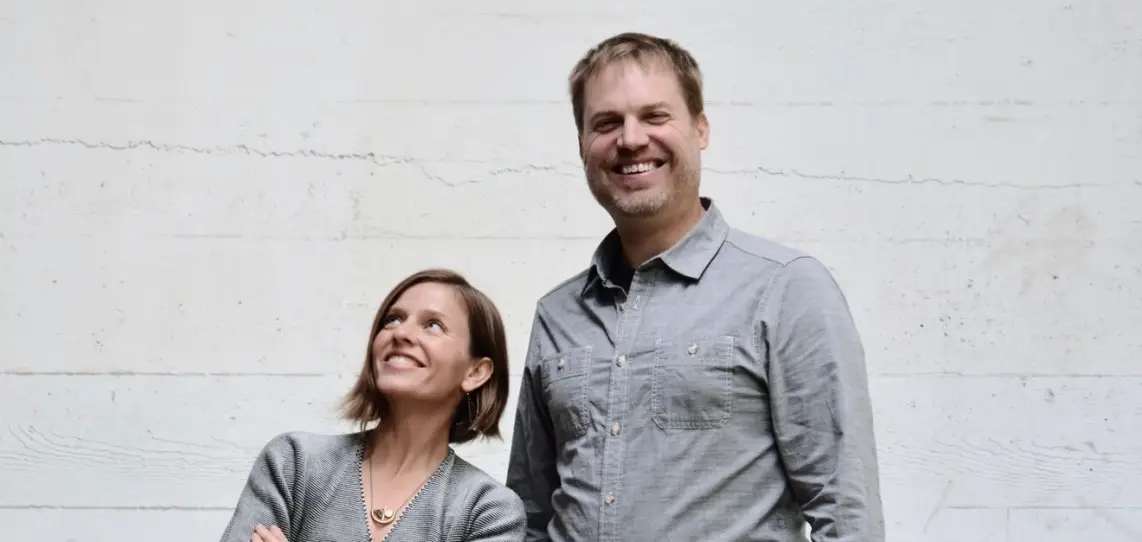
Green Hammer architects Laura Squillace and Jon Lundstrom bring more than 30 years of combined experience and a shared love of nature and collaboration to their work. Since joining Green Hammer more than eight years ago, they’ve partnered on numerous projects, including New Day School and Trillium Townhomes.
Today, as co-directors of design, Laura and Jon lead Green Hammer’s design practice while mentoring our growing team of architects. Their shared leadership reflects the mutual respect they’ve developed over years of working side by side, as well as an appreciation for the distinct skills, perspectives and personalities each brings to the team.
We recently asked Laura and Jon to reflect on how their experiences, leadership styles and strengths complement one another, and also share some of their hopes for the future of Green Hammer’s design practice.
Q. As a designer, what inspires you?
LS: As an architect, I am primarily inspired by my clients’ hopes and dreams. It’s a joy to help clarify a client’s vision and translate it into drawings they can see. However, I’m also constantly inspired by how buildings can deepen our connection to a place and to nature. This relates to my passion for creating healthy, climate-positive buildings that are beautifully daylit and made with local materials that reflect the inherent beauty of the Pacific Northwest.
JL: Nature inspires me. I see the endless amount of colors and textures as a launching place for curiosity. I bring that curiosity to projects to uncover both earth-friendly and beautiful solutions. I constantly find myself returning to nature for inspiration and am always amazed by its ability to adapt and respond.
Q. How would you each describe your leadership style?
LS: I do my best to cultivate a creative team that values collaboration, sustainability and creativity. I listen and care deeply about my team’s well-being and growth. I encourage myself and others to take time to explore the options. There is always more than one answer and we all find a lot of joy in the design process.
JL: My leadership style is based in listening. Listening is critical to working with my strengths around creative problem-solving and connecting with others. I need to listen intently to understand the constraints and opportunities in front of me. With listening, I bring a lot of patience to my interactions with others and believe no one person is the expert.
Q. What are the advantages of serving in the co-director of design role together?
LS: We have worked together for a long time. Jon and I have always been very collaborative. We complement one another’s proficiencies and passions. For instance, Jon has an incredible capacity to research, comprehend and communicate complex technical information, specifically about building science and building regulations. On the other hand, I am a quick thinker and love generating design options and communicating them with beautiful visuals for clients. Within Green Hammer’s unified design build process, we can both thrive.
JL: The design process is really important to both of us. Having the opportunity to co-direct the design team allows us more space to participate in the design process by sharing the non-design responsibilities.
It’s also great to collaborate and play to each other’s strengths. For example, I am a preparer and prefer to take time processing information. However, sometimes you need to move quickly. And, while that behavior may move me outside of my comfort zone, I know I can check in with Laura, who excels in these situations.
Q. How has the climate crisis shaped the way you approach architecture?
LS: As we learn more about the causes and effects of climate change, our design approach has shifted. For instance, we used to focus on reducing the operational energy of the building, but now we’re trying to focus equally hard on minimizing the embodied energy associated with the materials.
JL: I feel similarly. Early in my career, there was a strong focus on trying to reverse the impacts of climate change. Since joining Green Hammer, that focus has shifted. At least for me, the approach is now about how to mitigate the effects of climate change. So how do we adapt to climate change? The one thing we know at Green Hammer is that we have strategies in hand now that we are using to adapt to the changing climate and lessen our negative environmental impact. So it’s important to me that we lead by example, push for market adoption of these strategies, and find ways to disseminate that information inclusively.
LS: We’ve integrated theories of resiliency into our definition of sustainability. The word “sustainability” has an even more poignant meaning as we’re all now feeling the real effects of climate change in our daily lives and in how our buildings respond to extreme temperature fluctuations, power outages, pandemics, and more. We know climate change is having the most significant impacts on the most vulnerable and disadvantaged groups, so we’re working hard to expand our services to include affordable housing developers.
There’s strong support from the very top of our firm (Stephen) to reduce those impacts. It’s really empowering to work at a company where you feel like you can be part of the change.
When you look back at the past two years, what are you most proud of accomplishing together?
JL: We achieved significant milestones in our home designs and commercial projects that reflect the future of our journey towards more sustainable communities. In March 2026, we completed a comprehensive, biophilic-inspired home renovation featured in 1859 Oregon’s Magazine. The project highlighted materials that together delivered a more gracious, healthy and sustainable lifestyle.
We also completed the first Resilient Operations and Sustainable Energy (ROSE) facility at RoseVilla Senior Living, which is an earthquake-ready carport that can provide power and potable water off-grid during extended power outages.
These projects helped Green Hammer surpass our AIA 2030 Challenge, which targets making all new buildings carbon-neutral by 2030. We achieved a 100% reduction in operational energy use across our design projects in 2025, making our design portfolio carbon neutral.
LS: Over the course of the last two years, I’m deeply proud of the projects we’ve recently completed and the aspirational projects we’re embarking on now. Specifically, I’m proud of how beautiful and sustainable our recently completed Wallowa Retreat residence turned out. And I couldn’t be more excited about the project we’re working on now – a Wellness Center and multifamily pocket neighborhood that will be certified to the most aspirational green building standard in the world called the Living Building Challenge. Alongside these projects, I’m very proud of the expert team we’ve cultivated at Green Hammer over the past several years, from our talented designers to our tenacious project manager and skilled construction team out in the field.
Looking ahead to the next five years, what excites you most about where architecture and sustainable design are headed?
JL: Fueled by the growth of extreme weather events, a shortfall of housing and growing behavioral health challenges in our communities and aging demographics there is exciting movement towards re-investing in our existing structures, designing medium-density pocket communities that bridge a gap between a single detached home and a large apartment buildings and looking to not only passive resiliency strategies but regenerative ones as well across landscape, infrastructure and building design to elevate mental health, boost community morale and allow for faster rebounding following extreme events.
LS: I am very excited to see sustainable design broaden to focus not only on energy efficiency and healthy indoor environments, but also on natural materials, biophilic design, resilience, and regeneration. Now more than ever, our buildings need to help humans reconnect with nature, respond to climate change, and positively regenerate the energy, water and food systems that support us. What an exciting and pivotal time to be designing and building!
Photo by Steven Anderson