
What does it take to keep a community safe when the unexpected becomes routine?
At RoseVilla, a vibrant continuing care retirement community overlooking the Willamette River in Portland, that question is no longer theoretical. In recent years, residents and staff have weathered a growing list of disruptions — from multi-day power outages and wildfire smoke to extreme heat, ice storms, and a global pandemic. Each event has tested the systems that support daily life, from communication and transportation to critical care. In addition, with a 37% chance that a 7.0 earthquake in our Cascadia Subduction Zone will occur in the next 50 years, the looming potential of a large Cascadia earthquake is impossible to ignore.
For the community of more than 400 residents and 100 staff, resilience has become a necessity. In 2021, RoseVilla made the strategic decision to work with our team of consultants to create a resiliency action plan (RAP). The plan summarizes high-level recommendations to allow RoseVilla to anticipate, adapt to, and rapidly recover from a disruptive event.
The high-level recommendations developed in Phase 1 of RoseVilla’s RAP are now being analyzed in greater depth in Phase 2 to develop a realistic budget and timeline for implementation. This work will inform the development of Rose Villa’s Capital Improvement Plan, Facilities Maintenance Plan, Resilience Design Guidelines, and Emergency Response Plan.
Challenges
Large scope: There are many facets of resiliency that RoseVilla aimed to address. We focused on energy, water and structural resilience in Phase 1. After digging in, we all agreed air quality was just as important.
Competing for time: It can be a full-time job to shepherd a planning effort like this forward. Leadership must be prepared to support staff if they are required to participate in resiliency planning.
Resident involvement: RoseVilla residents are highly motivated to understand and contribute to the RAP. Managing residents’ expectations is an important consideration. For example, implementing strategies might not happen as quickly as expected. We formed a resident working group of six residents that meets monthly. They are all passionate, knowledgeable and dedicated to the plan.
Evacuation may be inevitable. No matter how much Rose Villa invests in implementing its RAP, campus-wide operation independent of the grid is near impossible. After weeks of providing shelter-in-place with off-grid energy and water supplies, evacuation may be inevitable to allow rebuilding and remediation to occur safely and efficiently.
Approach
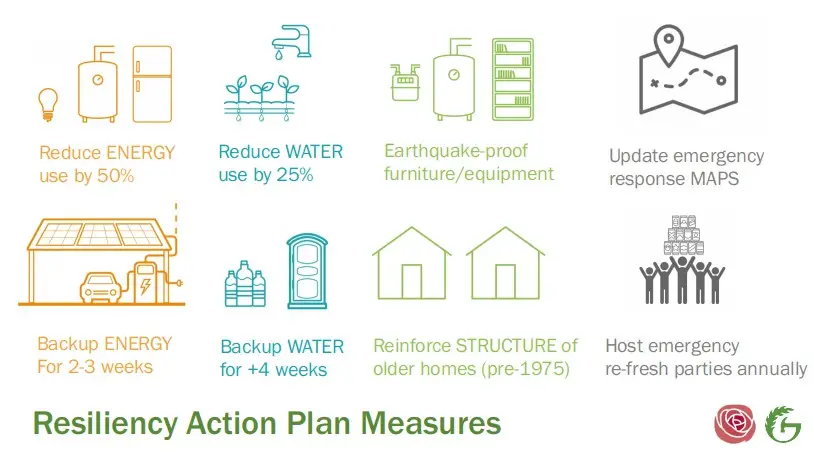
We kicked off RoseVilla’s RAP by leading key team members through a Visioning Workshop, where we defined the organization’s resilience, assessed potential disruptive events, and prioritized systems based on risk severity. The team included their CEO, executive director, director of campus development, and director of strategic operations. We collaborated to set goals that were both aspirational and realistic. The scope of the RAP primarily included seismic, energy, water, and emergency response, but it also touched on air quality and fire resistance.
We then hosted several workshops focused on each of these specific areas. Again, we enlisted the help of experts, including PAE and Equilibrium Engineers. Throughout all Phase 1 discussions, it was apparent RoseVilla residents must play an integral role in selecting and refining the solutions set out in the RAP in the second phase.
Results
As of November 2022, we completed Phase 1 (discovery) of the Rose Villa RAP. The RAP has a 20-year timeline broken into five phases. Careful thought went into phasing Rose Villa’s RAP goals and identifying the synergistic relationships between proposed strategies so efforts and investments build on each other efficiently and logically.
We are now in Phase 2 of RAP planning, refining the strategies with a more detailed analysis of the associated costs. In addition, we are facilitating a monthly meeting with a resident working group to garner feedback and leverage their expertise and commitment to implement some of these resiliency strategies.
The goals set by Rose Villa in its RAP are ambitious. Yet they are achievable with proper investment of time and resources.
Resiliency measures go hand in hand with sustainability measures. Clients can reap the benefits of their resiliency measures every day through reduced operating costs, more comfortable indoor environments, and healthy indoor air quality. Leadership, staff, and residents feel good knowing they are part of a community that is leaving the planet a better place for their children and grandchildren.
Learn more
Watch a short video about RoseVilla’s RAP.