
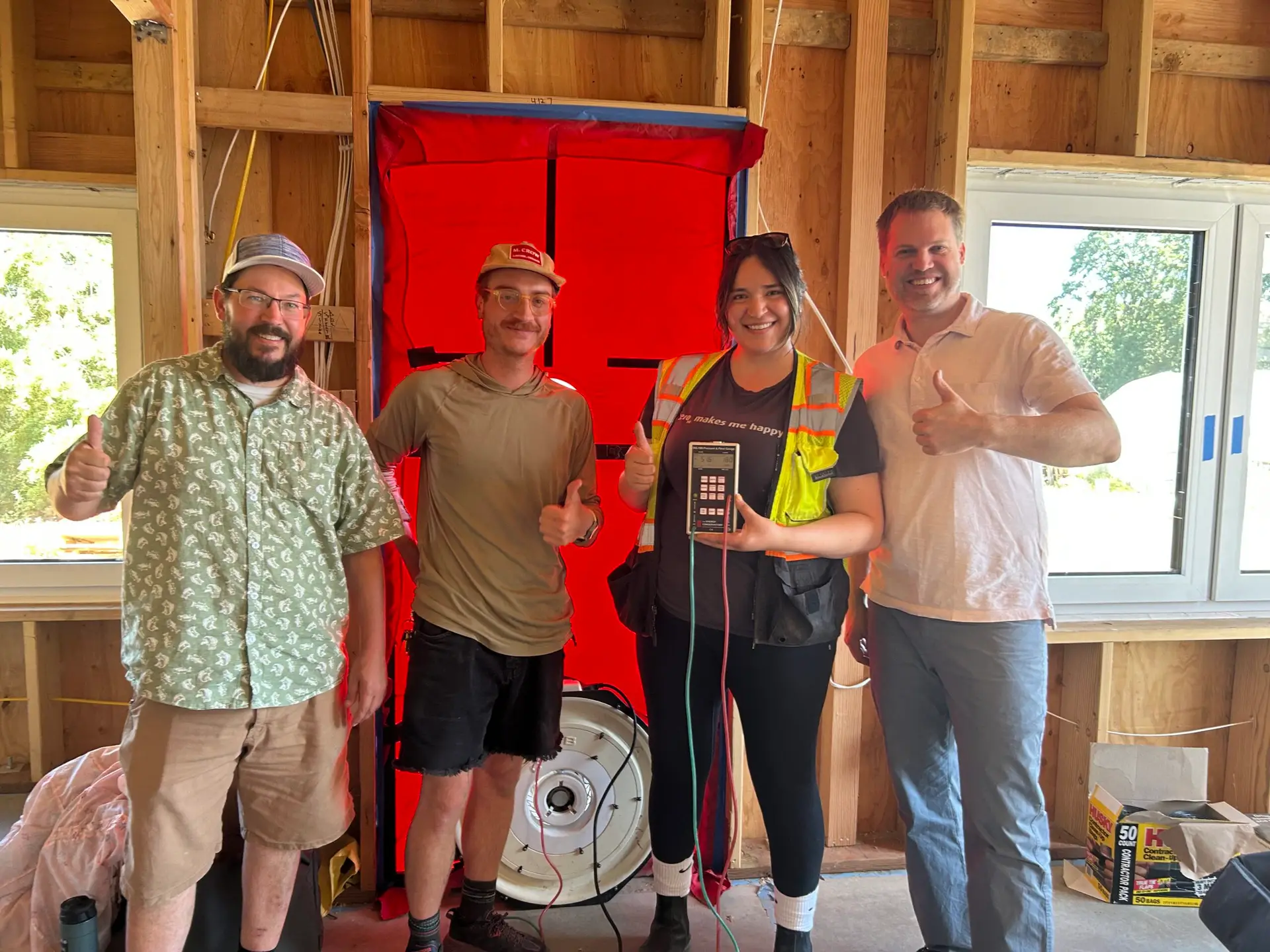
Conducting a blower door test is a common way to determine how airtight a building is, and where air is leaking in and out of a building. In new homes, we conduct two blower door tests: one mid-construction to catch leaks early, and a final test after the home is finished. (The final test is required by building code in Oregon and many other states.) When undergoing renovations, we might conduct a blower door test at the beginning of the project and again once it’s finished.
During this test, we mount a large calibrated fan in an exterior doorway and use it to pressurize or depressurize the house. This allows us to measure airflow and pressure differences, and to see where air easily escapes.
What we learn from a blower door test
- How airtight a building is: We measure airflow through the fan in cubic feet per minute (CFM) and use it to calculate air changes per hour (ACH), or the number of times all the air in your home is replaced in one hour under test conditions. A lower blower door test score indicates a tight, energy-efficient building that will have more even temperatures. To provide a healthy indoor environment, airtight buildings must also have proper ventilation.
- Where air leaks are happening: In older homes, air leaks often occur around windows and doors, electric outlets, plumbing penetrations and recessed lighting.
- Energy-efficiency potential: Fixing leaks during construction can save energy and money later. In existing homes, a blower door test helps pinpoint the improvements that will make the biggest difference.
- Comfort issues: Leaky homes can be drafty, cold in the winter and stuffy in the summer. Sealing leaks helps maintain even temperatures throughout the house.
- Indoor air quality and moisture risk: Leaky buildings allow dust, allergens and outdoor pollutants to enter. But if a home is super-airtight, moisture can get trapped, leading to mold. Understanding leakage helps balance airtightness with proper ventilation.
- Code compliance and certification: Many states require blower door testing to: verify compliance with residential energy codes, qualify homes for energy programs or incentives, and document performance for green building certifications.
Blower door test in action
One of our recently completed projects—a zero energy farmhouse outside of Portland—achieved an excellent blower door test score with a measurement of 0.04 CFM50/SF, far surpassing the Passive House standard. What does that mean? Imagine a 20-mile-per-hour wind pressing on every wall, roof and floor. Even under that pressure, this home leaks less than a ping-pong ball’s worth of air per minute for every square foot of building. That’s not just good—it’s exceptional.