
With buildings being responsible for about 40% of global energy consumption and 33% of greenhouse gas emissions, addressing building energy use is key to a low-carbon future.
At Green Hammer, we collaborate with many businesses striving to achieve zero carbon emissions in their operations, and buildings play a critical role in that journey. Here are some helpful tips for businesses considering a major building renovation project and onsite renewable energy project.
Before You Get Started
Hire an experienced design builder. Green Hammer has more than 20 years of experience designing and building all-electric buildings that achieve zero energy and low-carbon emissions. We can help you effectively plan and implement your new construction or major renovation.
Assess your overall energy consumption. When advising on a new renewable energy project, we start by conducting an energy audit to understand current energy usage. We also identify opportunities for energy efficiency improvements before investing in renewable energy systems.
Implement energy efficiency measures. We apply the Passive House standard, which reduces building energy loads by 60-90%. We achieve deep energy reductions through superior insulation, airtight construction, high-performance windows, and advanced ventilation systems. The more energy-efficient your building, the smaller and less costly your renewable energy project needs to be.
Explore financing options.We work with utilities and organizations like the Energy Trust of Oregon to secure cash rebates and the U.S. Department of Agriculture to obtain grants. We also provide documentation for state and federal tax credits. These can significantly offset the initial investment costs.
For example, we assisted New Day School in Portland with renovating two buildings and fundraising for an 45.5-kilowatt solar system. New Day became Oregon’s first zero energy preschool. Check out the case study and this podcast for more details on our successful collaboration.
Evaluate site potential: We work with experienced solar energy consultants to ensure optimal system design and integration with your building’s infrastructure. They will complete a site analysis that assesses the site’s solar potential. Factors like roof orientation, shading and available space help us determine the feasibility and efficiency of renewable energy installations.
Consider scalability. Plan for future expansion by designing systems that can be scaled up as your energy needs grow or as technology advances.
For example, we helped Rose Villa Senior Living design a 74-kilowatt solar system for The Oaks that spanned the south-facing rooftops and south-facing carport. And we went a step further by collaborating with them on a Resiliency Action Plan that includes future solar and battery expansion that would provide back-up power to the entire senior living community for 2-3 weeks.
Monitor and optimize performance. Implement monitoring systems to track energy production and consumption, allowing for ongoing optimization and maintenance.
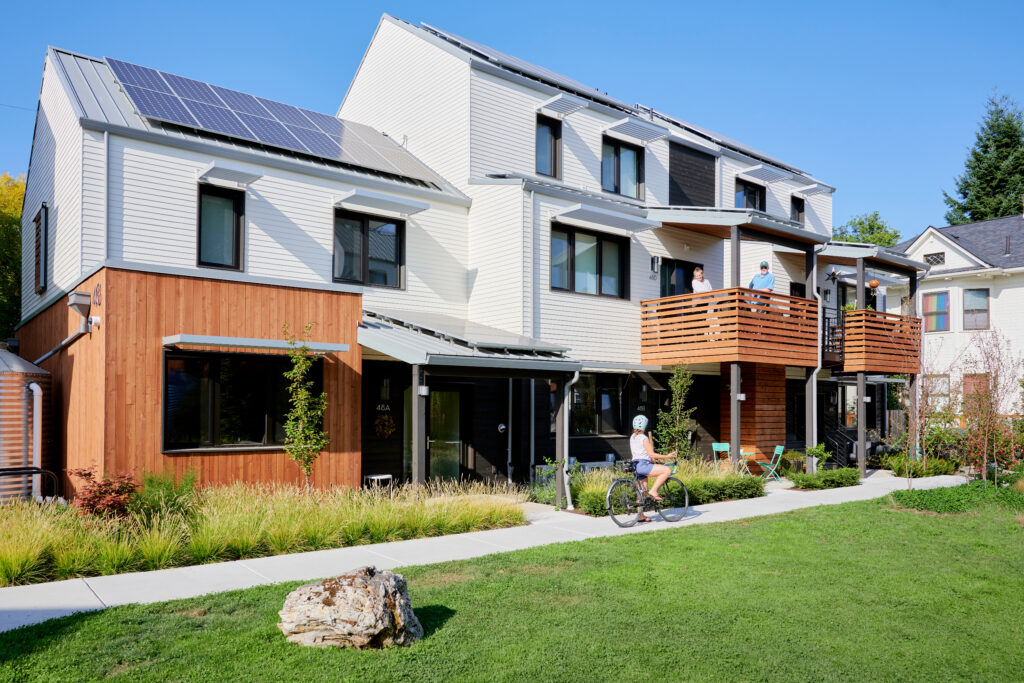
For example, at Tillamook Row, an energy monitoring system installed in the common house allows all residents to see the community’s electricity usage and solar electricity generation in real time. In addition, Purple Air monitors in individual apartments allow residents to see that indoor air is, on average, at least 30% cleaner than the outdoor air. Tillamook Row has been part of numerous green building tours, with more than 350 people touring the community as part of educational events.
Understand maintenance requirements. Factor in the maintenance needs of your building’s heating, cooling, solar and other systems to ensure long-term performance and reliability.
Promote Your Commitment
Leverage your investment in energy conservation and renewable energy as a marketing tool. Highlight your commitment to sustainability to attract environmentally conscious customers and stakeholders.
By following these tips, businesses can effectively plan and implement onsite renewable energy projects that are both economically and environmentally beneficial.